
Why use a Vacuum Conveyor?
Vacuum conveying is well suited for batch transfer applications that move powders and bulk solids from one process step to the next. Material is conveyed from a pickup point and discharged into mixers, blenders, hoppers or other process equipment.
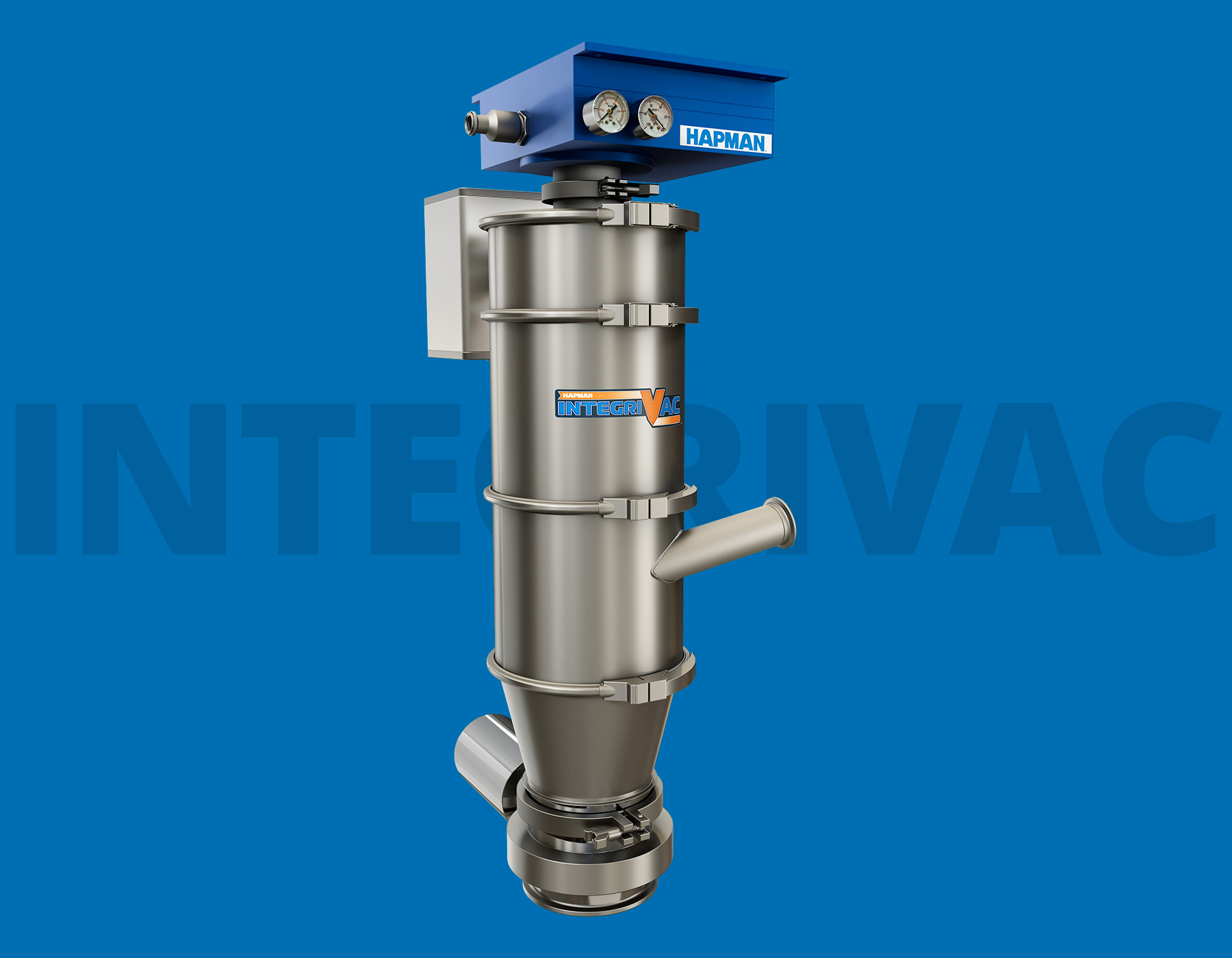
What Sets Hapman’s IntegriVac Conveyor Apart?
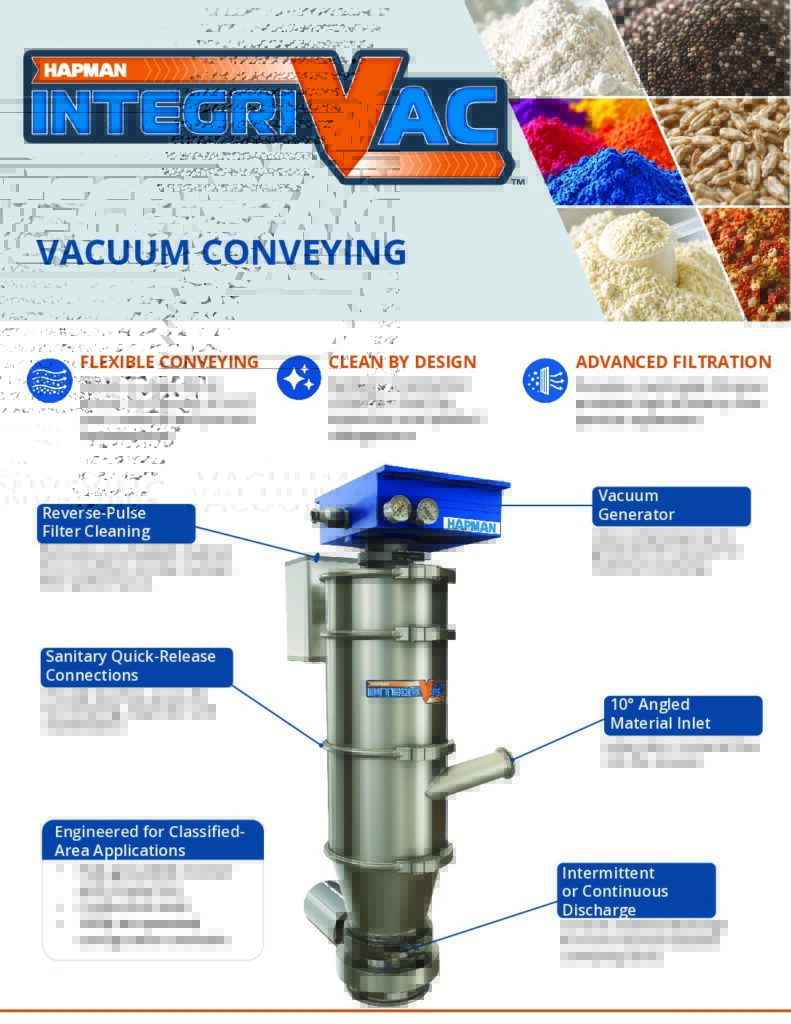
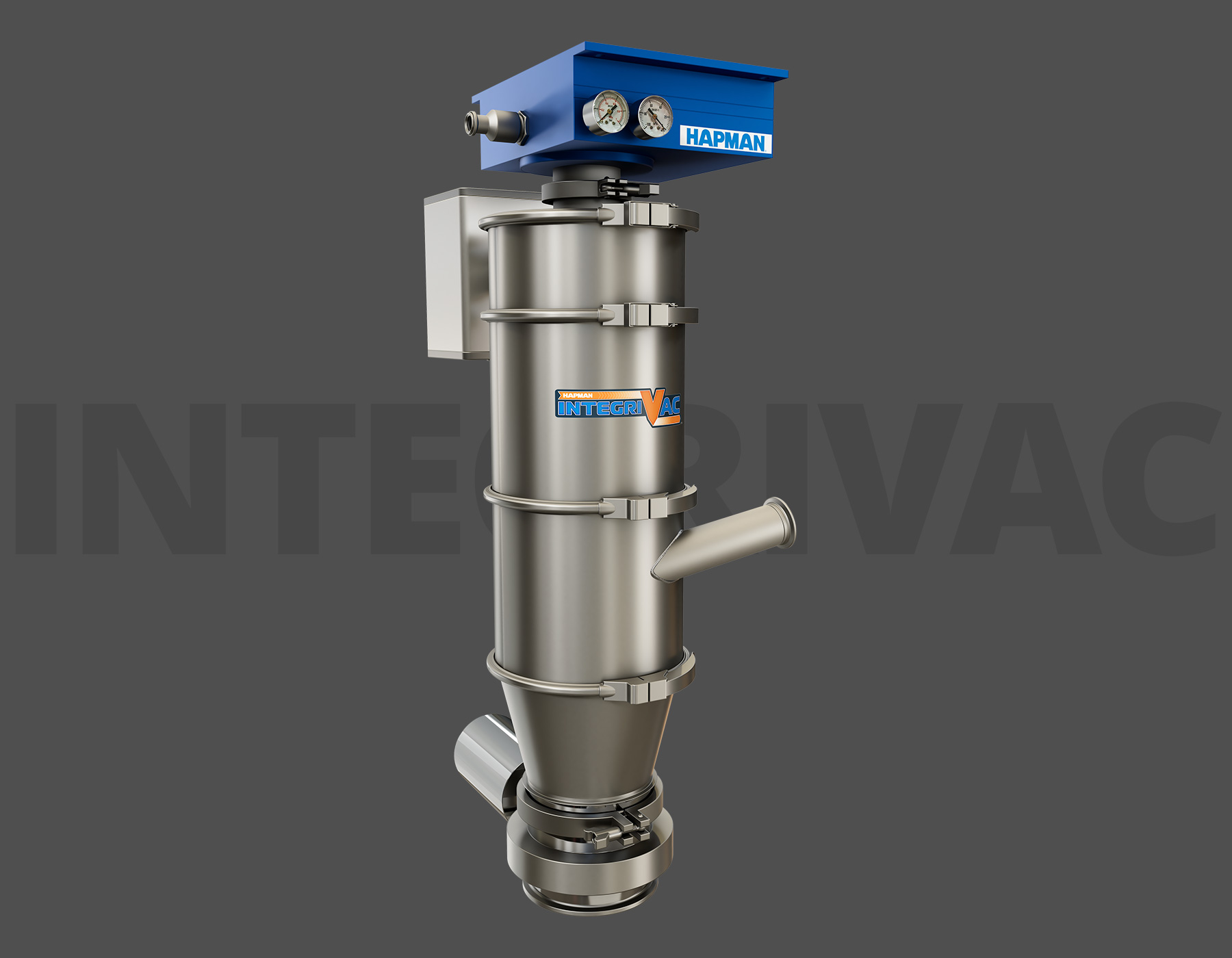
IntegriVac is Hapman’s modular, quick-clean vacuum conveyor engineered around the material and process. Sanitary quick-release connections support fast, one-person disassembly, while Herding® Filtration Technology provides fine-particle separation with reverse-pulse filter cleaning. IntegriVac can be configured for 100% pneumatic operation or with electric vacuum and controls, with conveying behavior tuned to the application. Designed, manufactured and supported in the U.S., it is backed by Hapman application engineering and material testing.
Integrate the IntegriVac with other bulk material equipment from Hapman like the Bulk Bag Unloader, Bag Dump Stations, or Bulk Bag Filler for a complete conveying system.
The Hapman Performantee®
Our Performantee is a 100% operational guarantee that you will be fully satisfied with the performance of our equipment, and that it will achieve the specific results for which it was designed and manufactured. If not, we will revise or repair it to deliver the results we promised.
Product Details
Features & Specifications
Each component is built for clean, dependable conveying, with quick access for cleaning and inspection. Every IntegriVac™ is configured around your material and process with a volume up to 1.5 CFM and density up to 250 lb/ft³. Talk with our team to size the right system for your application.
Receiver
Stainless-steel construction with sanitary quick-release connections for cleaning and inspection.
Vacuum
Multi-stage pump uses compressed air to generate the conveying vacuum.
Filter
Herding® solid sintered PE with a microporous coating.
Cleaning
T-handle coupling allows quick auger removal for cleaning and maintenance.
Discharge
Controls material discharge from the receiver between conveying cycles.
Herding® Filtration
IntegriVac uses Herding® filter technology, which captures fine particles at a microporous surface instead of trapping them deep in textile media.
Durable
Rigid sintered polyethylene holds its shape and stands up to repeated cleaning and use.
Sterilizable
Washes and sterilizes at up to 250°F to support cleaning and product changeovers.
Food-Contact
Suitable for applications with strict product-contact requirements.
Separation
Separates particles down to 0.5 micron, keeping conveyed material out of the exhaust air.
PFAS-Free
Current Herding® filter media and surface coating are PFAS-free.
Inlet Options
Choose the inlet that matches how material reaches the conveyor, from manual pickup out of containers to metered feed from upstream equipment.
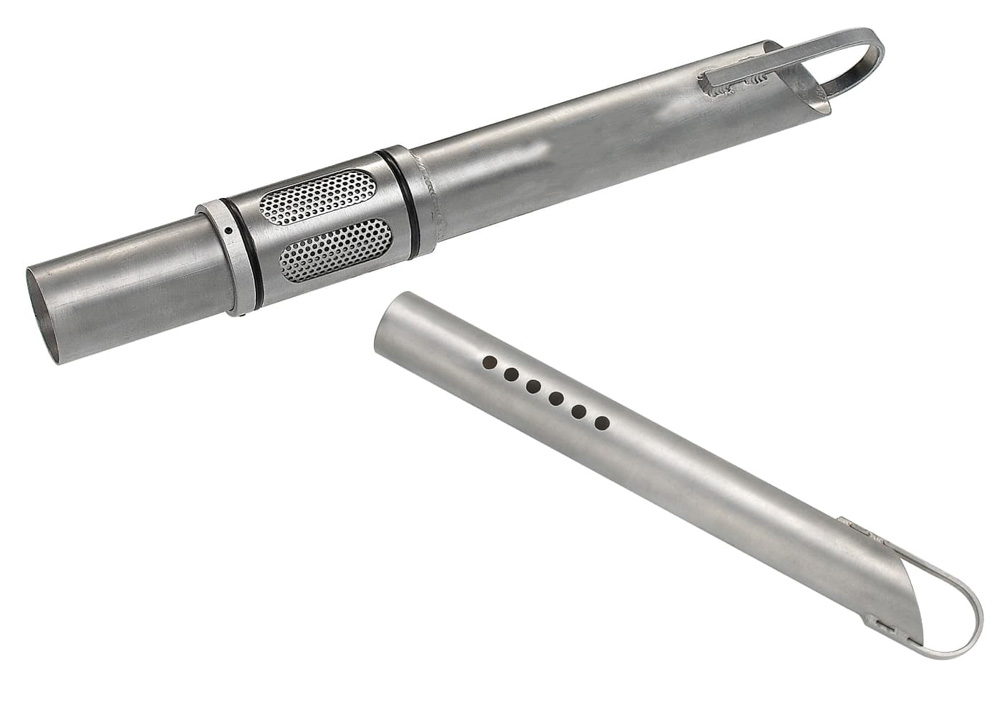
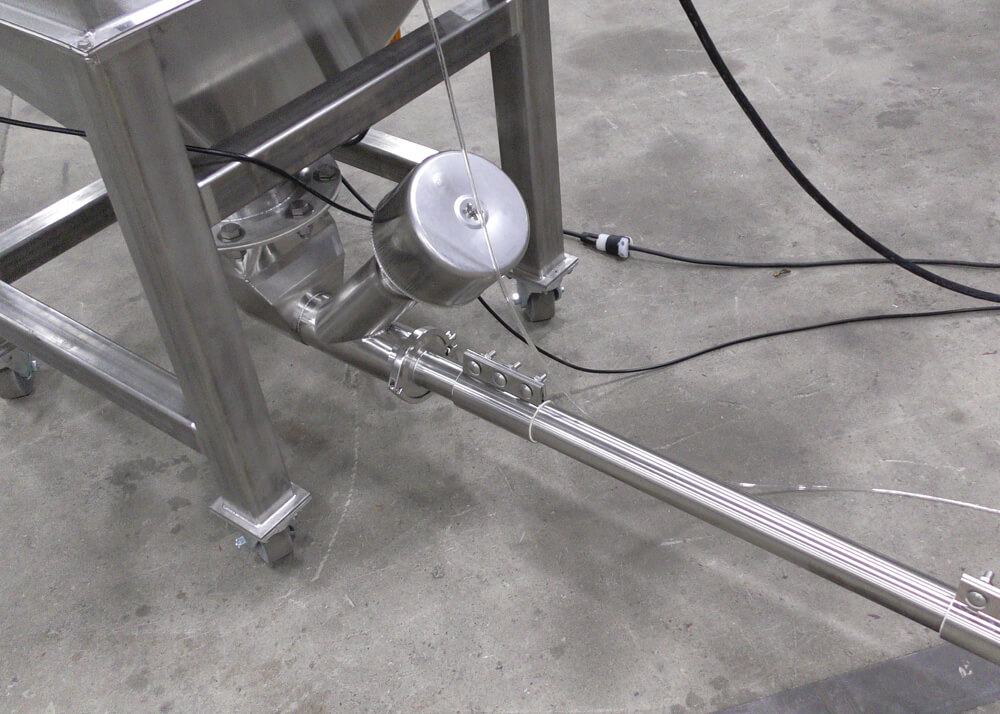
Pickup Wand
Draws material directly from the source while introducing conveying air from above to maintain the proper air-to-material ratio.
Best For
Drums, boxes, and other containers
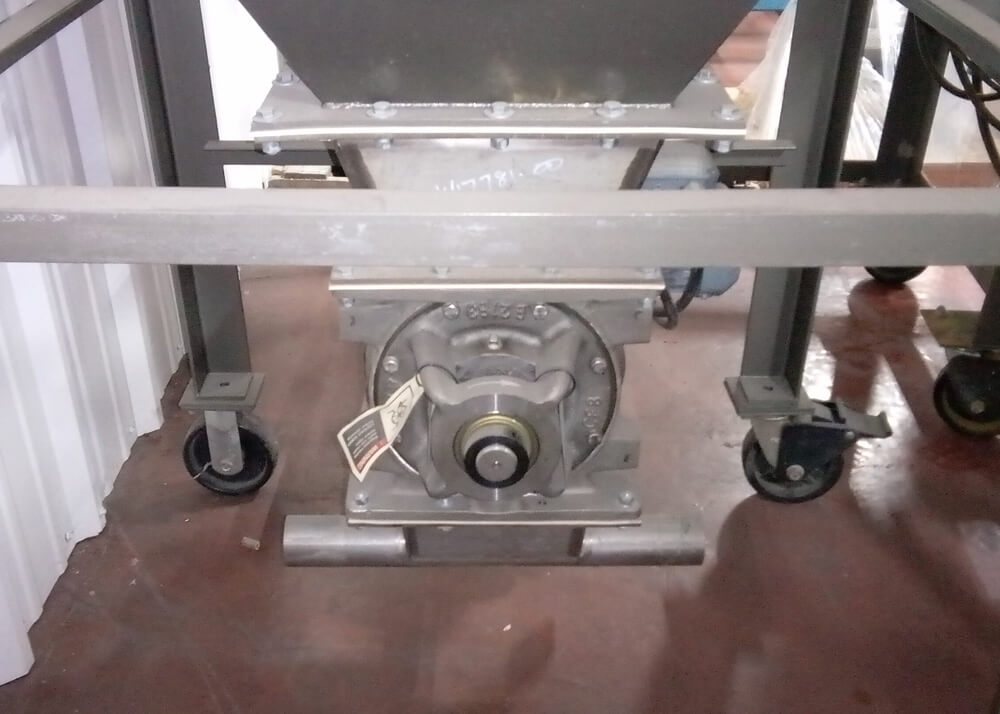
Flooded Well
Allows material to enter from a hopper or surge bin while introducing conveying air to help prevent choke feeding and line plugging.
Best For
Hoppers and small surge bins
Blo-Through
Introduces material into the conveying line from equipment such as a rotary valve or feeder.
Best For
Metered material feed
Industries
Hapman’s engineering team has helped customers with IntegriVac applications in the following industries:
Chemical & Pharma
Food Industry
Pet Food
Get Started with IntegriVac
Want to see why IntegriVac is the best fit for your product? We can also run sample conveying tests on certain materials. Get in touch with our team to customize your specs to exactly what you need.
Want to talk to a technical specialist about your specs for vacuum conveying?
Looking for an alternative to vacuum conveying?
Explore mechanical conveying with the Helix® Flexible Screw Conveyor.
You’ve got questions? We’ve got answers! Check out our FAQs.
-
What is the difference between dilute- and dense-phase conveying?
Dilute-phase conveying uses more air and higher conveying velocities, with material dispersed throughout the conveying line. It is a simple, effective approach for many free-flowing powders and granules.
Dense-phase conveying uses less air and lower conveying velocities, with a higher concentration of material moving through the line. These gentler conveying conditions can help reduce abrasion and product degradation when material integrity is important.
Semi-dense phase provides an option between the two, using moderate conveying velocities and material concentrations. It offers a balance between conveying performance and gentler material handling for a broad range of materials.The right conveying phase depends on the material, required conveying rate and process conditions. IntegriVac can be configured from dilute through dense phase when the application supports it.
-
What materials can IntegriVac convey?
IntegriVac is designed for a broad range of dry powders and granular materials, including food ingredients, bakery powders, nutraceuticals, dairy powders, metal powders and many moderately abrasive products. It can handle materials across a wide range of bulk densities and flow behaviors. Wet or sticky materials are generally the biggest limitation and should be reviewed with a Hapman application specialist.
How is Herding surface filtration different from a conventional textile filter?
The Herding® filter used in IntegriVac is a rigid sintered polyethylene element with a microporous surface layer. Fine particles are separated at the surface rather than intentionally accumulating deep within a fibrous filter body. This supports automatic pulse cleaning, product recovery and consistent operating conditions. The element can also be washed and sterilized for product changeovers. -
Can a vacuum conveyor operate without electricity?
Yes. Some vacuum conveyors can operate entirely from compressed air without requiring electrical power at the conveying unit.
IntegriVac can be configured for 100% pneumatic operation, using plant air for both vacuum generation and controls. Electric vacuum and control configurations are also available based on plant utilities and process requirements.
-
Are vacuum conveyors suitable for food processing?
Yes. Vacuum conveyors can provide enclosed transfer of powders and dry bulk materials used in food processing. Equipment selection should consider product-contact materials, cleanability, filtration and access for cleaning.
IntegriVac is available with FDA-compliant product-contact materials, washdown-rated construction and quick-release connections that support one-person disassembly and COP cleaning. Its Herding® filtration technology is washable and sterilizable to 250°F.
-
How do you clean a vacuum conveyor?
Cleaning methods depend on the conveyor design, material and sanitation requirements. Vacuum conveyors may be disassembled, washed down or cleaned out of place (COP) between product runs.
IntegriVac uses quick-release connections and sanitary-style clamps to support fast, one-person disassembly. Its washdown-rated construction supports cleaning and product changeovers, while the Herding® filter can be washed and sterilized between product campaigns.
During operation, compressed-air pulses release collected material from the filter surface to help maintain filtration performance and airflow.
-
Is a 0.5-micron process filter the same as a HEPA filter?
No. Particle-separation capability alone does not make a process filter HEPA-certified. HEPA classification requires testing according to a prescribed test method.
Herding® filtration technology used in IntegriVac provides high-efficiency fine-particle separation down to 0.5 micron, but the filter is not marketed as HEPA-certified because it has not been classified using the applicable HEPA test methodology.
-
Should I use vacuum conveying or pressure conveying?
Vacuum conveying is often preferred when product containment, flexible pickup and compact transfer into process equipment are priorities. The line operates below atmospheric pressure, so leakage tends to draw air inward rather than push product into the room. Pressure conveying may be better for some high-rate, long-distance or multi-destination systems, though vacuum systems are applicable to multiple pickup and discharge points. Hapman evaluates both the material and process before recommending a conveying method.